

I have very specific opinions on how backend architecture should look. I subscribe to certain design patterns and principles, but manually enforcing those patterns across every new entity is a grind. It's repetitive, it's boring, and it's a massive waste of engineering time.
We define a field in the database. Then we define it again in a Zod validator. Then we define it a third time in a TypeScript interface. I've seen the "solutions" out there and honestly, none of them hit the mark.
The Problem: The Three Worlds of Fragmentation
Right now, developers are forced to maintain three separate versions of the same truth.
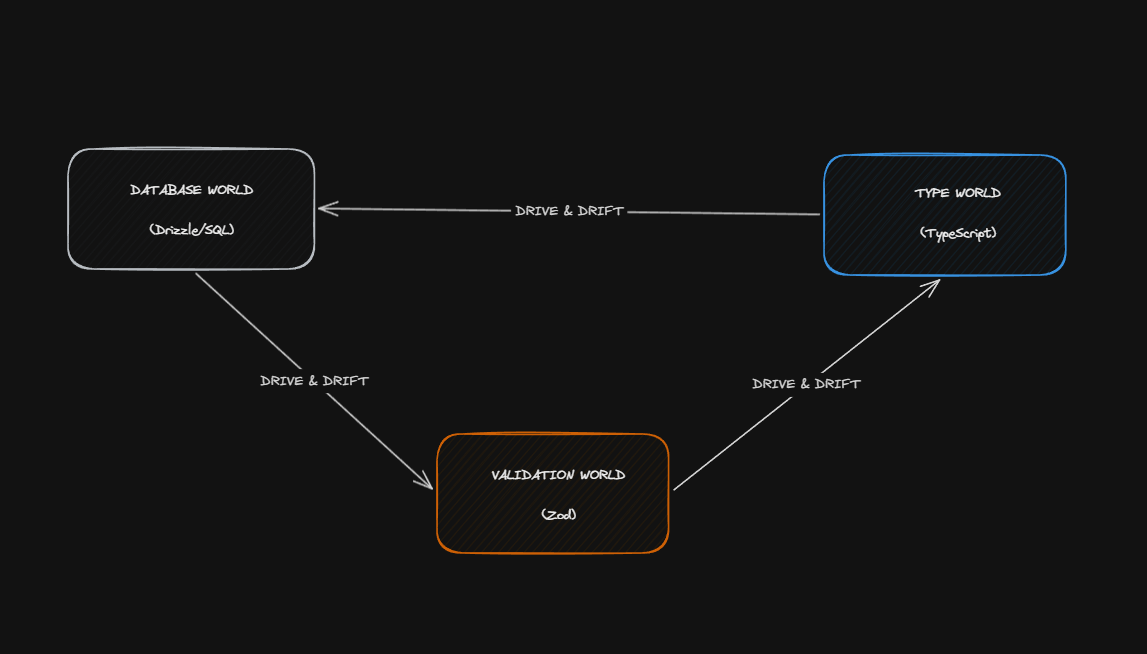
When these worlds drift apart (and they always do), you get runtime errors, type mismatches, and database migration nightmares.
A Deterministic Idea
We should stop settling for the probabilistic slop of AI-generated code. Why roll the dice on a generator's best guess when we can have a deterministic engine that actually respects our architectural opinions? Define the standard once and let the tool tether the application together.
Tether is a tool I'm building in Rust that follows a strict pipeline to turn my ideas into code. It forms the automated core of my full-stack TypeScript engineering workflow.
How it Works: The DNA and the Brain
You define your entity once in a tether-schema file. This is the DNA of your domain: fields, timestamps, and soft deletes.
The engine runs that schema through a transformation layer. It generates the repository schemas, validators, and types simultaneously. No more bugs where the validator, types, and database schemas disagree.
Tether maps a single domain type like int into three specialized strings: number for TypeScript, z.number() for Zod, and integer() for the DB or ORM. It takes this computed context and injects it directly into your .tera templates.
The Upper Floors: The Vertical Slice
If we stop at types, we've only solved a fraction of the problem. Types are just the basement. The real "monkey work" is the hundreds of lines of code needed to wire an entity into the rest of the stack.
Tether doesn't just stop at types. It writes the Repositories, Services, Controllers, and Routers based on the patterns I subscribe to. Since it uses a clone-template feature, it can follow your specific patterns too.
Define once. Write once. Use everywhere.